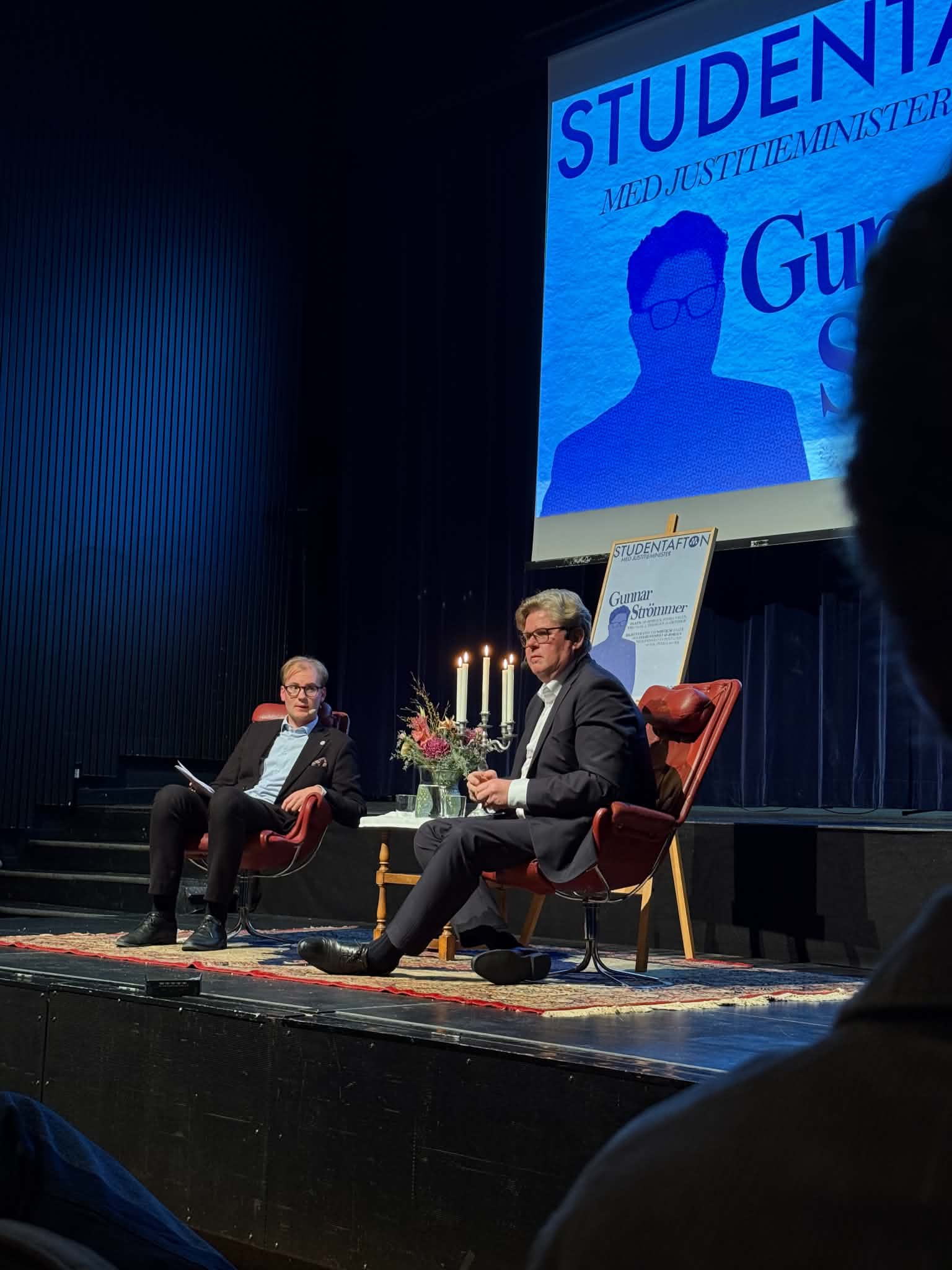
Ninety-nine out of a hundred. That is Sweden’s score in Freedom House’s assessment of political rights and civil liberties. For Gunnar Strömmer, the missing point offered a starting point: how could a country celebrated for freedom and democracy struggle so profoundly with gang violence? His ambition, he said, was to reclaim it.
The evening ranged from teenage contract killers to the future of Swedish politics. A lawyer by profession, Strömmer seemed comfortable turning Studentafton into something resembling a criminal law seminar. Fortunately, his dry wit kept it from feeling like one.
From Crisis to Change
To understand the government’s reforms, Strömmer argued, one must understand the Sweden it inherited in 2022. That year, 62 people were killed in shootings. He identified several contributing factors: segregation, failures in social services, barriers to information-sharing and criminal networks adopting an entrepreneurial approach. His description of “crime as a service” was particularly striking: violence had become a commodity in an increasingly sophisticated criminal marketplace.
Four years later, the figures look different. During the first half of 2026, eight people were killed in shootings, compared with 34 during the same period in 2022. Strömmer cited stronger policing, international cooperation and expanded investigative powers. The decline is substantial, although linking it directly to government reforms is harder. Several changes are too recent for their long-term effects to be assessed. Sweeping reforms, however, do not automatically make for a straightforward verdict on their success.
What Is Punishment Really For?
When moderator Oscar Falk challenged the effectiveness of harsher sentences, Strömmer questioned the premise. Effective at what, exactly? Punishment, he argued, serves several purposes. Prison prevents offenders from committing further crimes while incarcerated, but sentences also express justice and acknowledge harm already inflicted.
That distinction shaped his defence of abolishing the sentencing discount for multiple offences. Traditionally, additional crimes contributed progressively less to the total sentence. Why, Strömmer asked, should one victim’s suffering count for less because the perpetrator has harmed others? The argument shifted attention from crime statistics to the individuals behind them. Strömmer acknowledged that recognition, support and how authorities treat victims matter alongside the sentence itself.
Falk also raised the financial burden of expanding Sweden’s prison system. Strömmer acknowledged the cost but posed a counterquestion: what is the cost of doing nothing? Every krona spent on prisons is unavailable elsewhere, yet crime carries costs that rarely appear in government budgets: fear, lost freedom, violated privacy and permanently altered lives. The challenge is deciding whether the alternatives cost society more.
The Uncomfortable Trade-Offs
The conversation grew more difficult when it turned to children. Sweden has lowered the age of criminal responsibility to 14 for certain serious offences, drawing criticism from legal authorities and children’s rights organisations. Strömmer described children recruited to commit murders and youth institutions struggling to rehabilitate offenders. What should society do, he asked, when a 14-year-old has already committed murder? It is an uncomfortable question, though the need to act does not establish that imprisonment is the best solution. The reform’s five-year trial period will test its consequences. He also maintained that earlier intervention by families, schools and social services remains crucial to keeping children out of crime.
Privacy posed another dilemma. Defending preventive surveillance, Strömmer asked about the rights of a woman whose home is destroyed by an explosion while she sleeps. Her privacy, too, has been violated. Protecting one person’s integrity may require limiting another’s, he argued, making judicial oversight and safeguards especially important.
A Matter of Priorities
Strömmer also defended the pace of reform. Swedish lawmaking, he suggested, usually resembles either a marathon or, during emergencies, a 100-metre sprint. What the country needs is a 3,000-metre pace. Behind the metaphor lay a tension between expert advice and democratic choice: research can assess punishment’s effects, but cannot alone decide what society considers fair. That, he argued, is a question of values.
When the discussion shifted to the uncertain parliamentary situation, Strömmer became less forthcoming. Asked whether he saw a solution to government formation, he replied: “Yes, but I’m not going to tell you.” A fittingly evasive answer from someone otherwise given to elaborate explanations.
Ultimately, the evening was less about proving every reform successful than explaining the thinking behind them. Strömmer’s central argument was that justice cannot be measured only through statistics, budgets or offenders’ rights. It must also account for those harmed by crime. Whether the overhaul delivers lasting results remains uncertain, but one question lingered: in protecting individual freedoms, have we sometimes forgotten whose freedom was taken away in the first place?