In 1999, a music festival in the middle of the California desert lost nearly 1 million dollars. It was so bad that Rage Against the Machine gave back half of their fee, and at the time, it looked like one of the worst ideas in festival history. Fewer than 40,000 people showed up, even though the target was almost double that. The idea itself felt unrealistic, a multi-day festival, in extreme heat, far from major cities, at a time when the music industry was still focused on CDs, albums, and physical sales. Live shows mattered, but they weren’t the main event – yet.
That very festival would however, less than 20 years later, be making over 100 million dollars in a single year. It grew from 37,000 attendees across two days into a six-day pop-up city with hundreds of thousands of people. So what changed?
At the beginning, Coachella was built around a very different idea of what a festival should be – it was music-first. Like other early festivals, it carried that slightly rebellious, almost “outsider” identity. You went because you liked the music, because you wanted to discover something, because it felt different from mainstream culture.
The early lineups reflected that. Artists were not just chosen for mass appeal but for what they represented. And there were moments that defined that identity, like when Daft Punk performed in 2006 on the famous Pyramid Stage. It wasn’t just a concert, it became something people talked about for years. That kind of moment was not about visibility or content, it was about experience.
One of the biggest turning points came in 2003 with the introduction of camping. It sounds simple, but it changed everything. When people are sleeping there, eating there, staying the entire weekend, they stop being just attendees, they become temporary residents. And that means they spend more. More on food, more on drinks, more on the experience itself. That’s when Coachella started evolving from a risky idea into a sustainable model. By 2004, it sold out for the first time.
Coachella slowly became more than just a music festival. It became a place where things happen. Not just performances, but moments. Things that go viral, things that circulate online, things people talk about even if they were not there. The 2012 Tupac hologram moment is a perfect example. It showed that Coachella was not just about being there physically anymore, it was about being seen, even globally. This year, the concert had about 125,000 attendees over the three days, both weekends, once again becoming the main source of content, especially with the lineup featuring Justin Bieber and Sabrina Carpenter, giving birth to hashtags such as #BIEBERCHELLA and #SABRINAWOOD.
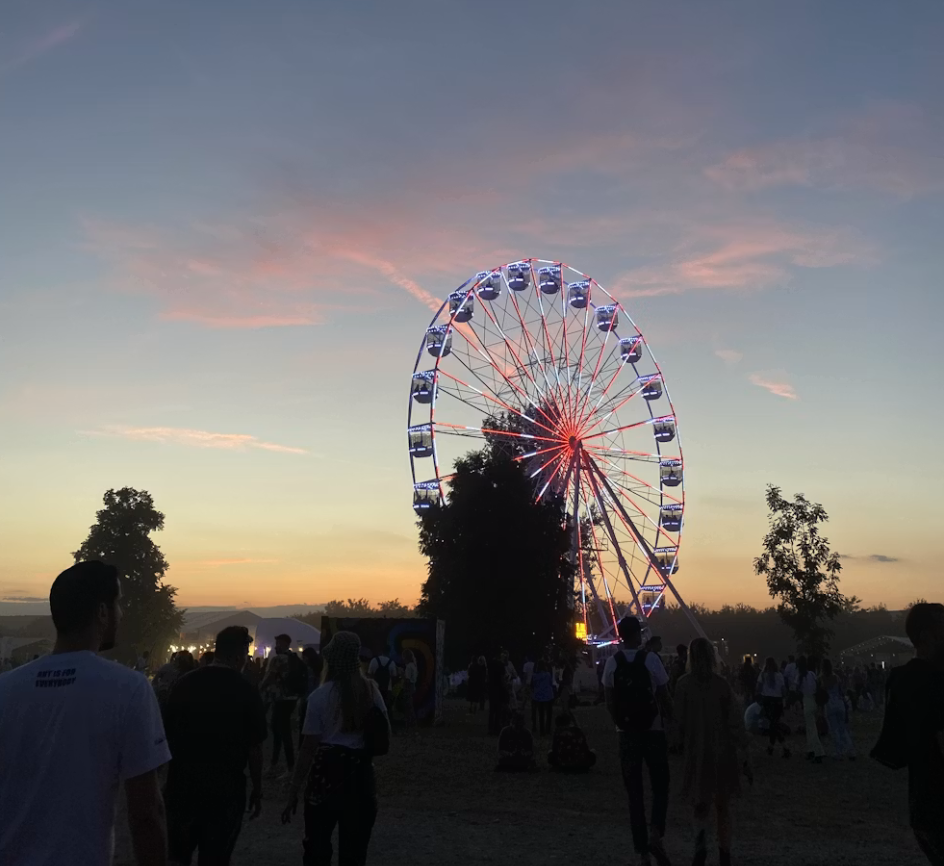
And that’s where the duality really starts to appear. Because today, Coachella exists in two completely different ways at the same time. On one side, you still have people going for the music. They are standing in crowds for hours, moving between stages, dealing with the heat, the dust, the long lines. They are there to see artists, to experience performances, to be part of something live. That version of Coachella still exists.
But at the same time, there is another version. A completely different one.
Influencers flying in on private jets. Staying in Airbnbs that cost tens of thousands of dollars. Getting styled outfits, filming content every second, and attending brand-sponsored events. In that version, Coachella is not really about music anymore, it is about image.
The festival has become performative.
Going to Coachella today often means more than just attending. It means showcasing yourself. Posting, documenting, being visible. Social media has completely reshaped the purpose of the festival. Instead of “I’m going because I like the lineup,” it becomes “I’m going because I want to be there.” There’s even this idea of attendance as self-branding. You are not just a person at a festival, you are content at a festival.
And brands are fully integrated into this. They fly influencers out, host them in “guest compounds”, provide free products, and organise photoshoots. It is a mutually beneficial system: individuals gain exposure, and brands gain marketing reach. Everyone benefits, but the focus shifts further away from the music itself.
This is also where the economic side becomes very visible. Ticket prices alone have gone from around $50 in 1999 to over $500 for general admission today, and over $1,000 for VIP. Resale prices can reach $6,000 or more. But that is just the start. Accommodation prices skyrocket during the festival. Food, transport, outfits, it all adds up.
And then there is the extreme version of this: the “rich side” of Coachella.
Private jets. $80,000 Airbnbs. $5,000 outfits. Entire compounds with multiple villas, private chefs, IV drips, stylists, and scheduled “content hours”. People are spending close to $200,000 for a three-day experience, and even questioning whether it was worth it. At that point, the festival becomes something else entirely. Not an event, but a luxury experience. Almost disconnected from the original idea of standing in a crowd watching live music. What is interesting is that this creates a visible contrast inside the same festival.
You have what people sometimes call “Buschella” on one side, people camping, cooking their own food, setting up tents, trying to make it affordable. And then, on the other side, you have a hyper-curated, almost artificial environment designed for influencers and celebrities
Same festival, completely different realities. And this contrast raises a bigger question: what is Coachella actually about now? Because originally, it was about music, community, and expression. Now, it is also about profit, visibility, and image.
That does not necessarily mean it has completely lost its original purpose. The music is still there. The performances still happen. People still go and genuinely enjoy it for what it is. But at the same time, the meaning of the festival has expanded, and maybe shifted. Coachella today reflects something broader about culture. The move from subculture to mainstream.
It is not just a festival anymore. It is a space where identity, money, media, and entertainment all intersect. And that is the duality. Coachella is still a place where you can stand in a crowd and watch an artist you love. But it is also a place where people go to be seen, to create an image, to participate in something much larger than just music.
The question is not really whether one side has replaced the other. It is more that both now exist at the same time. And maybe that’s exactly what Coachella has become: not just a festival, but a reflection of the world around it.