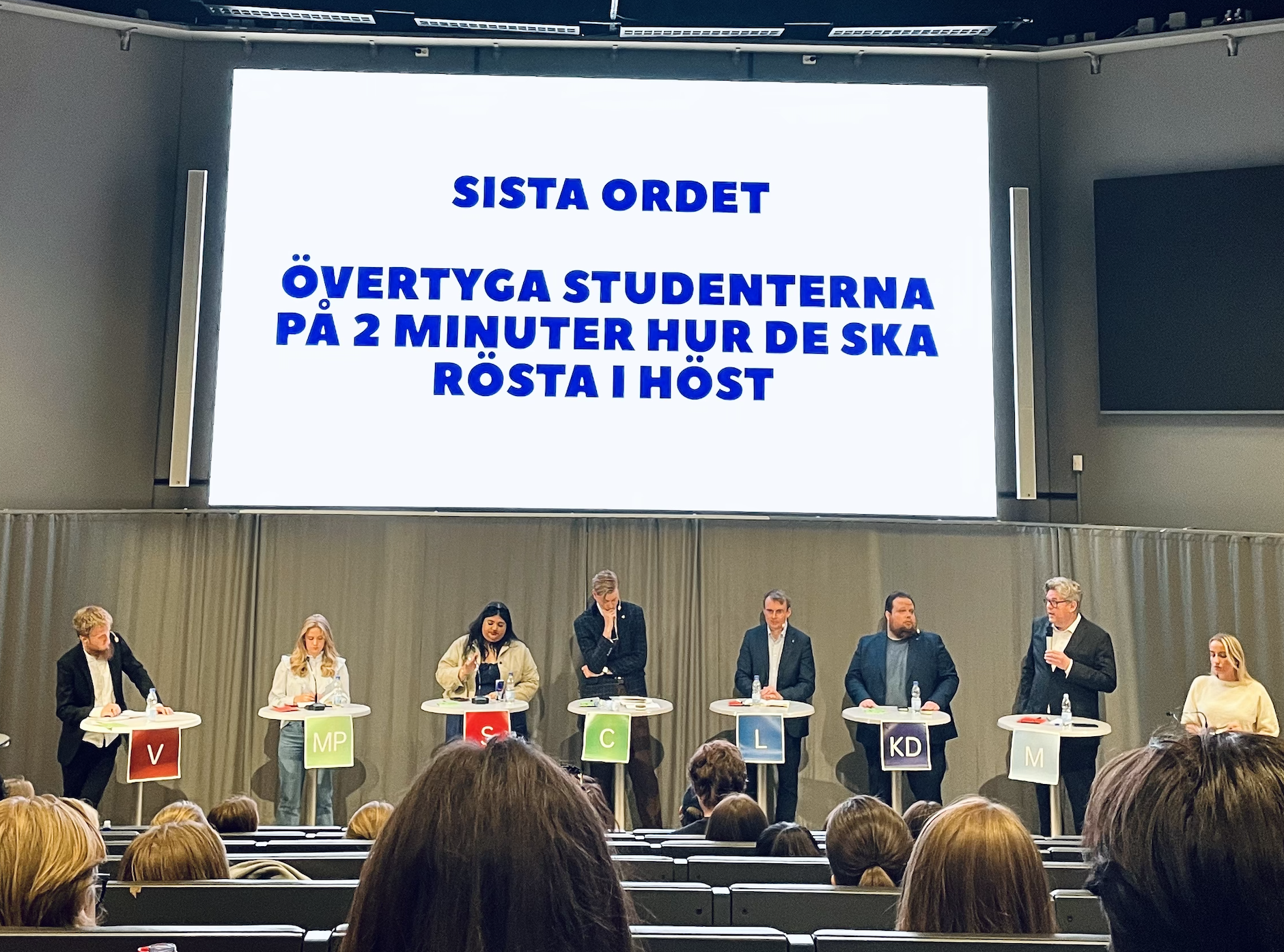
Palaestra is far from quiet when we enter the auditorium for this semester’s first and only party debate, brought to us by a collaboration between Lunds Universitets Politiska och Ekonomiska Förening (Lupef) and Utrikespolitiska Föreningen i Lund (UPF). The expectations are high and a short while after we have sat down, eight people enter, one representative of each Swedish party in parliament.
Throughout the evening, the politicians representing their parties did what all politicians do. They mixed conveying a vision of what their party wants Sweden to look like with taking jabs at their opponent when the opportunity is given. What is different however, is that all parties are adjusting themselves to try to appeal to us, a younger audience, and this is noticeable for the entire duration of the debate. With an election coming up in just a few months, we are, after all, valuable assets to any political party.
How Politicians Differed During the Debate
The first subject of the night was foreign policy, which set a solemn tone for the rest of the evening, touching upon global politics, war and energy crises. It quickly hit home, landing squarely on issues affecting citizens’ everyday wallets. The evening’s debate offered sharp clashes, ideological trenches, and more than a few biting remarks.
Deep divides over Sweden’s role in the world were evident right from the start. While the government side looked outward, calling for a stronger EU and a rearmed Europe that must learn to stand on its own without relying on the US, the opposition pulled the debate back home. The left countered, saying that Sweden is hardly ready for war when the railways are failing and the healthcare system is already on its knees, demanding contingency taxes to fund the military. Meanwhile, a different voice from the right wing demanded that Sweden turn its back on the EU entirely in favor of deeper Nordic cooperation.
Aid policy whipped up the tension
The sharpest exchange of the evening came when foreign aid fell under the microscope. When the right bloc defended their budget cuts by arguing that aid had been “made more efficient,” they were met with a wall of criticism. The opposition thundered that the slogan of “helping on the spot” falls flat when you cut funding at the same time, warning that the budget drops hit everything from everyday contraceptives to long-term security policy. The government was accused of prioritizing tax cuts for the wealthiest over international solidarity and of wanting to use foreign aid as a tool to deport criminals.
When the Euro issue was brought to the forefront, the political map was redrawn yet again. Here, the liberal and conservative forces stood completely alone in their resounding “yes” to the currency, while the rest of the room, from the far right to the far left, said no or demanded a new referendum.
Future optimism or pessimism?
With youth unemployment sitting at 25 percent, the debate about the future turned into a battle over reality itself. The opposition painted a dark picture where high school students are met with the grim prospect of immediate unemployment, demanding state job guarantees.
From the government bench, the tone was entirely different. They wanted to counter young people’s anxiety with tougher measures against crime, stepping in as optimists who pointed to falling inflation and a halving of deadly violence. When welfare came up, the left demanded billion-dollar investments over tax cuts, prompting the right to warn that high-tax policies risk driving the country’s wealthiest abroad. The debate on jobs was fittingly rounded off with a sharp swipe from the political center, noting that hardly anyone in Sweden even knows the name of the Minister of Employment.
Climate policy split the room in two
The evening concluded with a question that left no room for nuance. On whether Sweden’s climate ambitions are enough, the room split into two distinct blocks:
The left-wing opposition answered NO, accusing the government of missing every single goal, increasing oil dependency, and chaining themselves to the wrong support party instead of investing in electrification and railways. The government side answered a just as clear YES. They pointed toward future nuclear reactors, defended their crisis management, and ultimately dismissed the climate anxiety entirely by stating that the economy has stabilized, arguing that missing the targets on time was not a problem.
The 2-Minute Pitch
To wrap up the evening, every party representative got the chance to give a two minute pitch on why to vote for them, and no one went off script. The main points made by each party representative were the same ones made by the party in general.

SAFETY, FREEDOM AND SWEDISH IDENTITY:
“We want a Sweden that you recognize, where you can be proud of being Swedish.”

HEALTHCARE AND GROWTH:
“Sweden is amazing but more needs to be done. We have started the work and we want to continue.”

EFFORT AND JUSTICE
“Effort should be rewarded and crime should be punished, this is a foundational part of society.”

SCHOOL AND INDIVIDUAL FREEDOM
“The Liberals are needed, not because we should all live the same life, but because everyone should live the life they want.”

ECONOMY, JOBS AND ENVIRONMENT
“We want to empower people, we want a society that invests in the future, we want a society where we experience the world together.”

FUTURE, YOUTH AND SECURITY
“Our generation has grown up among crises. It is time to invest in these people.”

WELFARE AND REDUCED LIVING COSTS
“We are the ones who dare. Dare to tackle the lack of competition, dare to strengthen the welfare state and dare to invest in our society.”