This is an opinion piece. Views expressed are the author’s own. LundaEkonomerna maintains a politically neutral stance.
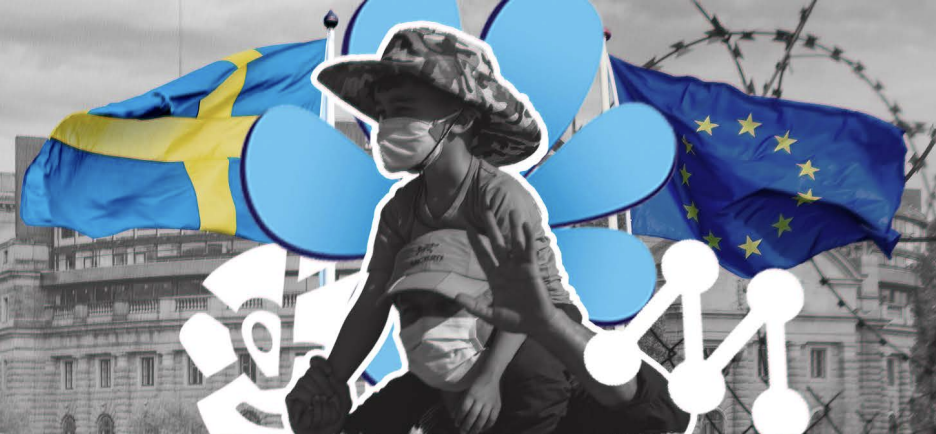
In 2015, Sweden experienced a refugee crisis, where war-stricken people from especially Syria emigrated to Europe. During this period, both the Swedish prime minister, Social Democratic leader Stefan Löfven, and the leader of the largest opposition party, Moderate Party leader Fredrik Reinfeldt, made statements that later became synonymous with the crisis. The quotes were:
“Mitt Europa bygger inga murar” and “Öppna era hjärtan”
The quotes, which translates to “My Europe does not build any walls” and “Open your hearts”, encapsulates a sentiment very prevalent in Swedish politics during the 2015 refugee crisis. The Swedish political parties, with the sole exception of The Swedish Democrats (Sverigedemokraterna), had a welcoming attitude towards accepting refugees into the country. The left and the right unanimously agreed to help the war-stricken refugees resulting in a bipartisan consensus rarely seen in Swedish politics. The reason I mention this is because today´s reality is a stark contrast to 2015.
Today, Sweden has some of the toughest immigration laws in Europe, and the amount of asylums granted has fallen by almost 95 percent compared to 2015. Moreover, Sweden has recently started to deport teenagers whilst their families get to stay in Sweden, which has resulted in teenagers being deported to war zones completely alone. The situation is reversed compared to 2015 – instead of a bipartisan consensus to accept foreigners, a majority of the parties now want to enforce strict immigration policies. How is that possible and what does it tell us about our biggest parties?
In my opinion, both the Swedish Social Democrats (Socialdemokraterna) and the Swedish Moderate Party (Moderaterna) have displayed breathtaking levels of hypocrisy in this matter. The current Moderate leader, Ulf Kristersson, who once vowed to a holocaust survivor to never cooperate with the far-right party Sverigedemokraterna, is now part of a coalition with them. Furthermore, the Moderates have essentially copied Sverigedemokraterna’s immigration policy – a policy which they just 10 years ago shunned as inhumane and barbaric. The Social Democrats have fully turned their policies around as well. Just recently, for example, they chose not to support a motion from parliament aimed at stopping the deportation of teenagers who have grown up in Sweden. The current leader of The Social Democrats, Magdalena Andersson, Minister of Finance in the Löfven Government in 2015, has also repeatedly stated that she is adamant about having a strict immigration policy.
I believe there is one central underlying reason for the sudden shift towards a more restrictive immigration policy. From 2015 and onwards, Sverigedemokraterna have risen rapidly in the polls, thereby dethroning the Moderate party in the 2022 election as the second biggest party. This has put the Social Democrats and the Moderate Party in a bit of a quagmire: either they have to uphold their beliefs, or succumb to the pressure, in order to not lose more votes to the Swedish Democrats (Sverigedemokraterna). As evident by this article, they choose the latter of those two options. Power can be a vicious incentive and I think the way the Moderates and the Social Democrats have acted shows that clearly. Beliefs that were once denounced by both parties, have now been adopted and turned into mainstream politics. In the pursuit of power it seems like no beliefs are holy. The question is: If the largest parties throw away their beliefs about immigration as soon as the polls start looking a bit bleak, what other previously highly held beliefs will be next?