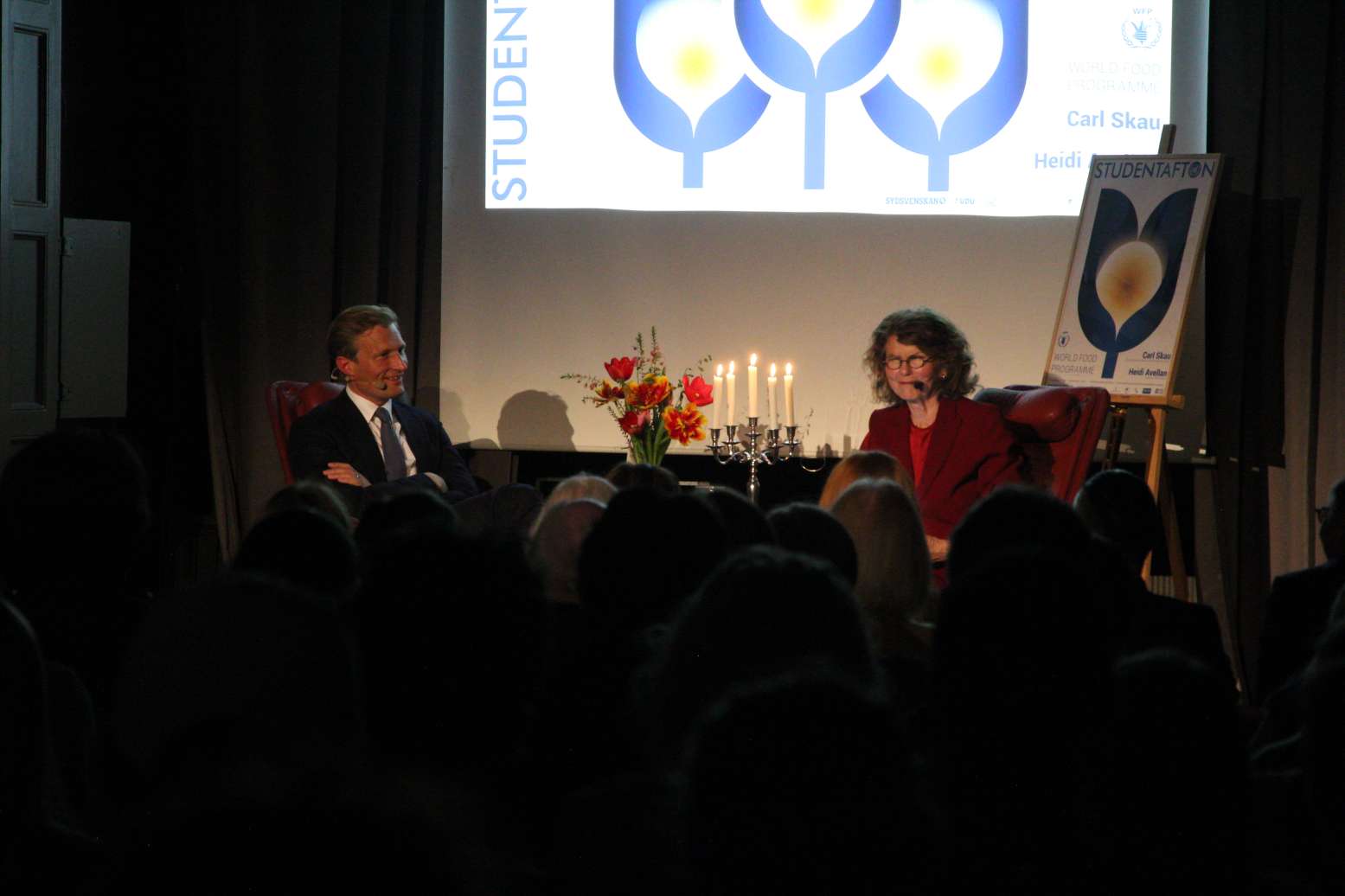
As you are reading this, 300 million people around the world are starving; up to 80 percent of those are children. Quite a bleak way to start an article. The third Studentafton of this semester started in a similar way. It was immediately made clear to us, the audience, that we may not have a very joyful evening ahead of us and already after the first few minutes we were left with a message I think summarized this Studentafton quite well.
“We live in a world where a lot of things are moving in the wrong direction”
The guests were Heidi Avellan, senior columnist, who shouldered the responsibility of moderating, and Carl Skau, Deputy Director and Chief Operating Officer at the World Food Programme (WFP). One of the first questions Carl is faced with is a rather common one: What does a regular day at work look like for you?
The idea of someone in a position like Carl’s having regular days is promptly shot down, when your work consists of crisis management whatever set schedule you may be following quickly loses its importance when your attention is needed elsewhere. The last week has certainly been one where Carl has been needed all over the world. High stakes board meetings, the resignation of his Executive Director, the continued work at the frontlines of countries in conflict as well as the emergence of a new crisis in Iran and the Middle East. In addition to this the last years have brought with them the need for constant efforts to improve the dire situation of the people stuck in our times’ most complex catastrophes: Gaza, Ukraine, and Sudan.
In Gaza, a place Skau knows intimately, WFP has fought for better food access, managing to sustain open bakeries and soup kitchens. Yet, the situation remains a total brutality—a vast civilian population is desperately squeezed onto a tiny, ruinous patch of land. They are enduring constant bombardment, living exposed in plastic shelters on the beaches or huddled in the wreckage of former homes. Skau describes the paralyzing uncertainty that hangs over everyone about the future.
The war in Ukraine, a “WWI trench war” in the middle of Europe, presents a different kind of horror. WFP focuses its daily deliveries close to the active front line, getting essential aid to hundreds of thousands of people. They work to bring a semblance of normalcy, aiding farmers to clear liberated land and ensuring children taking refuge in cold bunkers receive a warm school meal. Skau recalled the sheer misery of a brutal winter where heating and electricity infrastructure was deliberately destroyed, forcing entire families to sleep through sub-zero temperatures.
Yet, it is Sudan that Skau labels the world’s worst hunger catastrophe. A raging civil war, tragically fueled by external actors, has created an impossible, devastating situation. WFP is frequently denied entry and struggles to operate across constantly shifting conflict lines. This denial of access has led to the tragic loss of their own staff, a harrowing testament to the dangers of simply trying to deliver food.
While all of these catastrophes rage on, the world produces more than enough food for everyone. Carl is clear: the issue is not a shortage of resources – Starvation, he argues, is purely a problem of politics, diplomacy, security, and logistics, it is not a result of some limitation of resources. Conflicts are the primary drivers of hunger, essentially weaponizing food and blocking humanitarians from reaching the vulnerable. This political failure is compounded by a global system that often turns aid into an instrument of geopolitical self-interest. Donor nations increasingly restrict their money to narrow, specific programs, forcing the WFP to rely on its triage system, a hunger scale. They are forced to make unimaginable choices, pulling resources from the acutely hungry just to keep the most desperate from immediate death, knowing that every choice tragically pushes more people closer to the brink.
The pressure on the UN system is immense. The organisation operates with resources Carl describes as shockingly minimal compared to global military spending. The political environment is impossibly complex, marked by a dangerous sense that the rules are gone. This shifting global order, combined with surging needs and tragically dwindling resources, makes the work itself more perilous than ever. Skau shared a painful memory from El Fasher, Sudan, where an attempt to pressure warring parties by publicly displaying the aid trucks waiting to be allowed into the city resulted in said trucks being the targets of an attack that killed staff members.
Through all of this, Carl Skau still manages to wrap up the evening as a person who is hopeful of what is to come. He sees a world that will eventually come together, with the UN serving as the essential platform. This belief is driven by the collective human sentiment that “no one is safe unless everyone is safe.” For WFP, the victories—like reaching 5 million people in Sudan in a month, or the rapid response in Lebanon—are too often forgotten. They help over 100 million people a year. He finds hope in Gaza’s children, and in the impressive entrepreneurial spirit that springs up immediately during a ceasefire, where people open makeshift businesses in the rubble.
Carl Skau’s approach to this immense and crushing responsibility is captured in a phrase that guides his work:
“Hope for the best, plan for the worst.”