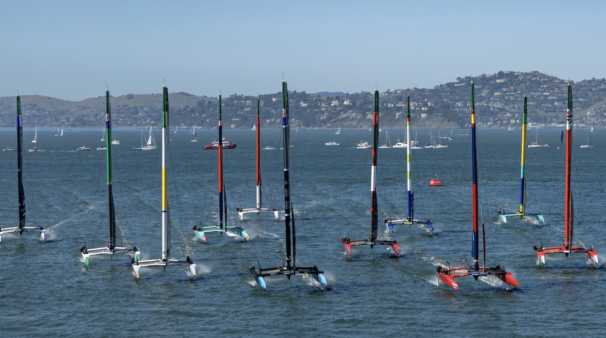
SailGP is a global sailing championship where top national teams race identical cutting-edge F50 hydrofoiling catamarans that reach speeds of over 100km/h, practically flying above the water. At these speeds, the boats rise onto hydrofoils and lift the hull clear of the surface. Maintaining this sustained flight is key. Their shared goal is to win the Rolex SailGP Championship and the $2 million cash prize, and to do so they must overcome the shifting nature of the wind.
Each team consists of around six crew members, all working together to maintain balance.
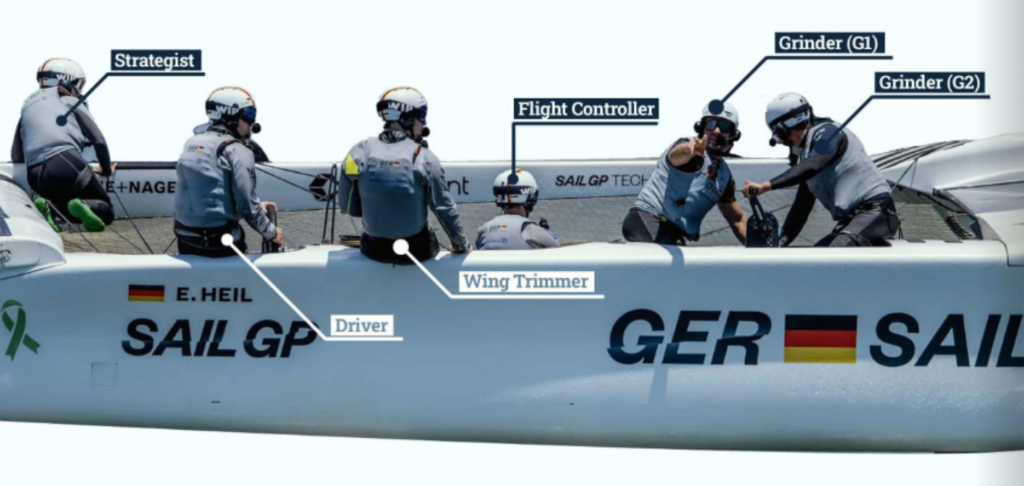
First you have the Driver, who steers the F50 and leads the crew, communicating the race plan to the rest of the team. The Strategist sits behind the Driver and monitors the wind, boundaries, and competitors, ensuring safe positioning and timing. Sitting in front of the Driver is the Wing Trimmer who adjusts the wingsail to match the wind conditions and advises the driver on the most efficient sailing mode.
The Flight Controller manages the boat’s height above water, quite literally controlling the boat’s “flight,” and works with the Driver and Wing Trimmer to maintain speed and stability. The two Grinders (G1 and G2) work together to power the winches. G1 is facing forward and helps to control the wing sail and maintain awareness of the racecourse; G2 is positioned to communicate directly with the Wing Trimmer for efficient coordination. Each role contributes to a single outcome: maintaining controlled flight over water in environments that continuously change.
Each event spans two days and takes place in major cities. There are seven races in total (four on the first day and three on the second), with the final race reserved for the top three ranked teams in a ‘winner-takes-all’ showdown. At the end of each event, teams are re-ranked on the overall leaderboard, and the top three qualify for the “three-boat shootout” at the Grand Final, where the champion is decided.
As each event concludes, teams are awarded points based on their finishing positions, ranked out of 10 points. 1st place receives 10pts, 2nd place 9pts, 3rd place 8pts, and so forth. There are 12 teams that race, so those that place 11th and 12th receive 0 points. This shapes the leaderboard across the season, where steady performance across multiple races is key. Strong finishes across several races build a team’s total, shaping the leaderboard before the final.
Every race begins with a timed start and lasts about 15 minutes. Teams enter the start box one minute before the signal, carefully timing their acceleration. Even here success depends on reading the weather correctly, as the course itself is shaped by wind conditions and marked by boundaries that keep the fleet close but far enough apart to overtake one another.
Like most competitions, penalties play an important role in maintaining fairness. A green circle highlights the boat with right of way, while a red circle shows which team must give way. Teams that break the rules must either drop a set distance or fall behind their opponent. Despite being designed for safety, these rules can also be used tactically, with teams pressuring their opponents to make mistakes.
The 2026 SailGP season is currently underway, having opened in Perth on Australia’s western coast in January, where races unfold under the intensity of a midday sun. What follows is rapid decision making, choosing the turn line, narrow crossings, and constantly shifting positions where even the smallest miscalculation can cost valuable places. Performance depends a lot on maintaining stable flight on the hydrofoils. As the speed increases, the hull lifts out of the water, reducing drag and allowing the boat to travel faster. This, however, requires constant readjustments to be made by the flight controller, who manages the boat’s height above the surface. If the boat dramatically drops or rises too fast it can lose speed and stability.
As wind conditions play a major role in balance and directional changes, crews need to act quickly and coordinate their movements in real time. Maintaining this awareness is a defining piece of SailGP racing, and as the season progresses across different locations, each event becomes part of a larger rhythm. The act of setting sail is repeated again and again, each time shaped differently by winds and conditions. No two races are the same.
At this early stage in the 2026 season, with only the Australian and Brazilian legs completed, the leaderboard is already starting to take shape. BONDS Flying Roos leads the standings with 35 points, ahead of the Emirates Great Britain on 28, while the U.S. SailGP Team sits close behind on 27, marking a competitive start to the 2026 season. The margins are small but these early performances set the tone as teams look to establish momentum into the rest of the season.
The early races offered an early glimpse of which teams may emerge as serious contenders for the Grand Final in Abu Dhabi this November. As the season sails from one coastline to the next, consistency, control, and speed will be the three determinants of success. New technology is driving the sport forward, but the outcome is still shaped by the same unpredictable factor, wind. In this way, setting sail becomes a matter of mastering something that can never be fully controlled.