All major Swedish cities have universities. All major Swedish cities offer an abundance of pubs, clubs, museums and events. However, not all major Swedish cities expect you to stand in line for 24 hours to get a ticket for Valborg. How come young people flock to town?
Lund is famous for its student life. It is the city meant to provide not only higher education, but to supplement it with associations, events and nations. Admittedly lacking in many other aspects of city life – Lund makes it up to their students by filling their days with especially student-led activities. Thus, the reasons for moving to Lund often entail having a certain will for participating in student life. However, as so often in life, the feeling of being trapped can drain almost any situation of its surrounding excitement. The option chosen for you, no matter its allure if the choice was your own, will never be an option you feel fully satisfied with. Hence why I found myself, on a Tuesday morning, loudly complaining over every part of life in Lund feeling like a constant fight. A fight for a place to live, a fight for a role that fits you, a fight for tickets to clubs, balls, and seminars.
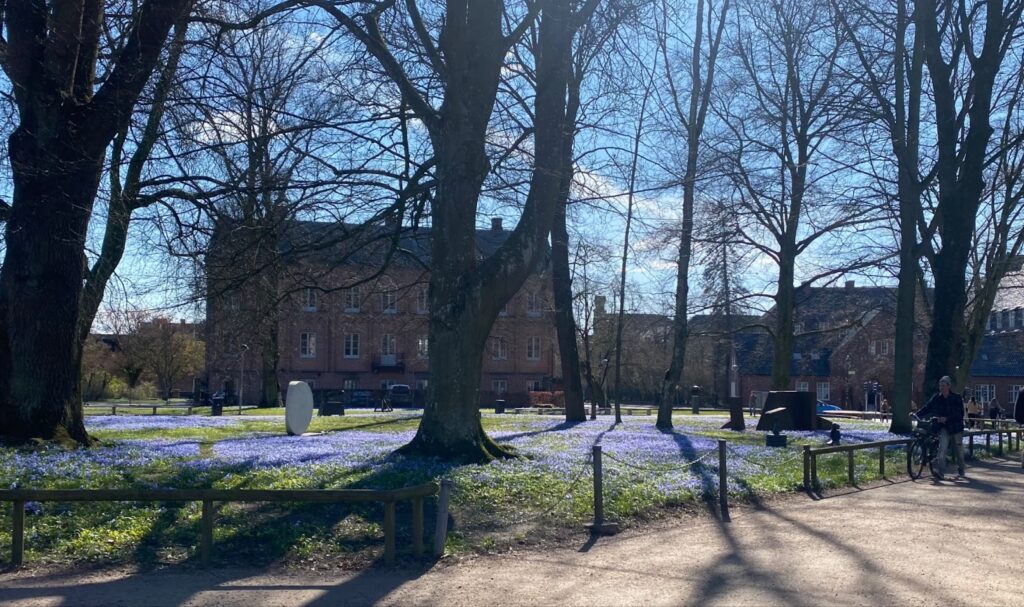
The life in Lund is in many ways one of the easiest lives one can lead. That very same morning, I had been cycling to school under the mild spring sun, admiring how the Scilla-flowers had turned the whole city purple. My last couple of weeks had consisted of basking in the sun while eating take-away Fengsson’s dumplings. Life had been far from a fight, so what led me there?
There are always fights to be had. There are always events to go to or jobs one would like to have. You can always be better and do better. However, if you are lucky enough, you can choose to stay where you are, content. In Lund, my feeling of entrapment stemmed from feeling like the choice was slipping away from me. My screaming about fights on a Tuesday morning had nothing to do with them existing or with things being competitive or difficult – it arose from the feeling that choosing to stay out of them, in Lund automatically becomes choosing to stay behind. The city is constantly moving not only forward, but upwards. As Valborg creeps closer and the nations open up their queues, thousands of students will make the active choice that a ticket to a day party is worth a 24-hour line. You could choose differently – but what is differentiating that choice from simply not succeeding? As the day approaches – are you feeling like you made a different choice, or just like you have been left behind?
Thus, no matter my Tuesday morning breakdown, I find myself leaving EC a couple of days later to go queue for night tickets for my planned Kvalborg celebration. Every person in line already managed to secure tickets. This line is meant for only one thing: If you are among the first ones to collect your wristband, you are guaranteed entry to the night celebrations as well. Every person in the line has therefore suddenly deemed their current tickets to be insufficient. New queues mean new possibilities.
—
The social events in Lund are fantastic, and the organisation behind them, truly amazing. That groups of students manage everything from housing to restaurants and balls, repeatedly leaves me in awe of what can be created. In many ways, the queues represent a democratic way of ensuring that every student gets the chance to be a part of the city’s events. Instead of all tickets being given out to members of different ranks, online ticket releases and long lines provide the possibility for new students to take part in the activities, as well as serve as an opportunity for different parts of the University to meet at the same events. The system is far from perfect, and surely, most new students still feel stressed, while most groups still stick to their own circles of known nations, unions and associations. However, the question remains: Is there a better alternative?
Does my breakdown stem from a faulty system, or simply human nature? That 45 000 students, including myself, would ever stop flocking towards the week’s major event, seems highly unlikely. After all, few things are ever enough. Luckily for us, in Lund there is always another queue to conquer.