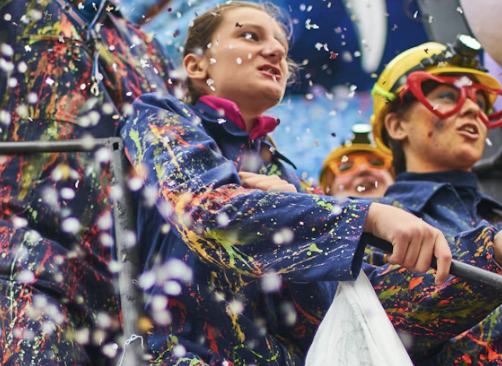
It is time! LundaKarnevalen is officially back. One of the defining features of Lund’s Carnival is its carefully selected annual theme. Over the past 150+ years, the themes have not only consistently rhymed, but they have been an expression of their time. The themes have ranged from being inspired by the Second World War, to reflecting on the “catastrophe” of Covid-19. Looking through the archives of photos and themes, offers a spotlight into the events and concerns shaping society at the time, alongside a look back into Swedish, and world history.
A brief history
From humble beginnings, the festivities origin can be traced back to a “brondbröllop” (farmers wedding) organised by Smålands Nation in 1849. Where students, dressed up in suitable attire as to resemble a farmers wedding, walked from Lund to Lilla Råby to have a party.
In 1863,the format for the carnival we know today was finalised, with the first ever theme being Grekiska Thronens försäljning, roughly translated to “the Greek thrones market”. Since 1867, the Carnival has turned into tradition, following a theme and occurring every 2/4 years (barring interruptions from world wars, and depressions).
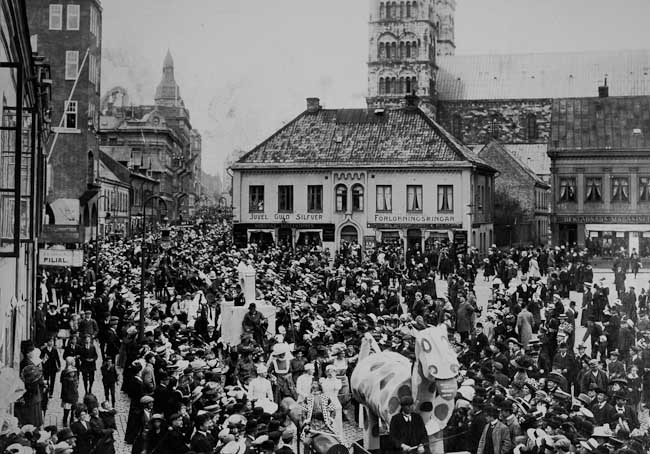
The first recorded photograph of Lund’s Carnival in 1912. Source: Kulturportal Lund
Before cars, most of the carnival was held on horses. The year’s theme was Olympiska Förspelen: a testament to the Summer Olympics held in Stockholm in 1912. This is known today as the “Swedish Masterpiece”, as it was the first Olympics to introduce electric timing, photo finishes and pentathlon.
1928: “Kulturkarneval” – Cultural Carnival
The 1928 Cultural Carnival reflected the spirit of the late 1920s, the post-war era. Widely regarded as the happiest and most carefree years of the interwar period.
1934: “Det tredje rikets dag” – Third Reich Day
The 1934 Lund Carnival used the theme “The Third Reich,” presented symbolically as an animal kingdom. It featured caricatures of Adolf Hitler, Hermann Göring, and Joseph Goebbels, serving as a direct satirical attack on the Nazi regime.The student newspaper Lundagård later described the theme as politically naive. They argued that the carnival treated a dangerous and radicalizing regime as comic material. This contributed to a negative reputation for Lund and was a significant underestimation of the seriousness of events unfolding in Germany in 1934.
1946: ”Det stora folkuniversitetet” – The Great Folk University
The theme “The Great Folk University” reflected the idea that education should belong to the whole people, not only to an elite. It played on the concept of folkuniversitet (the people’s university), which was linked to adult education and democratic learning in Sweden. It was also tied to postwar optimism.
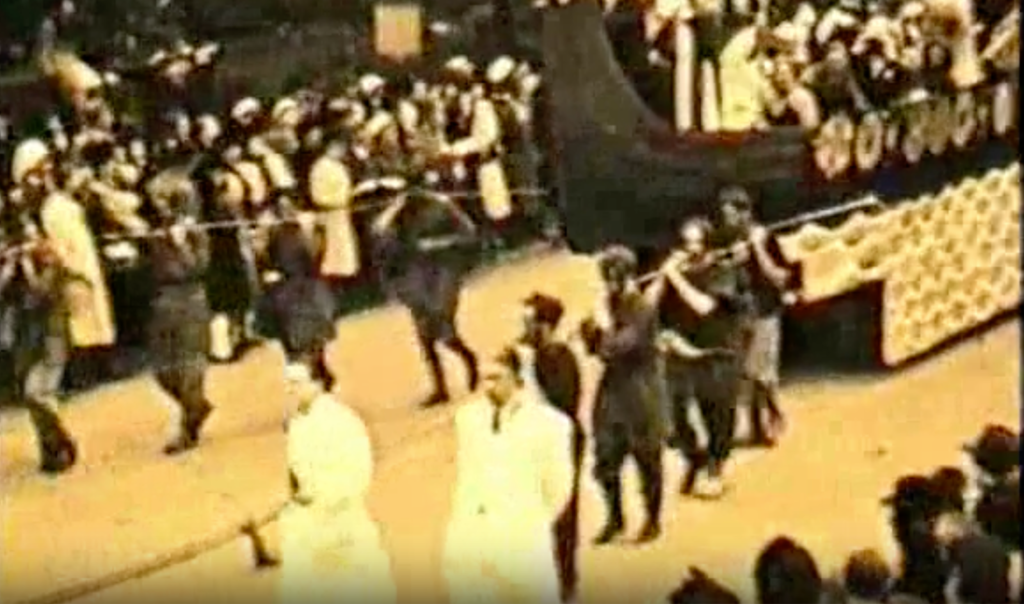
Source: Kulturportal Lund
1950: “Jubileumskarneval” – Jubilee Carnival
The likely celebration of 50 years of (more or less) consistent Carnivals.
1954: “Skandalkarneval” – Scandalous Carnival
In the 1950s, Sweden was stable and increasingly prosperous, but it was also socially conservative. Public morality, authority, and respectability were still strong norms. The students thus took to mocking what Swedish society deemed “scandalous”, resulting in the year’s theme.
1978: “Energikarneval” – Energy Carnival
This theme directly reflected the intense debate over nuclear power in Sweden during the 1970s. After the 1973 oil crisis, energy security became a major political issue. At the same time, concerns about nuclear safety and environmental risks were growing.
1982: “Stjärnkarneval” – Star Carnival
The 1982 “Stjärnkarneval” (“Star Carnival”) reflected the growing influence of celebrity culture and mass media in the early 1980s. During this time, Sweden had famous figures such as ABBA, tennis star Björn Borg, and actress Ingrid Bergman, who held the hearts of Swedes and fans worldwide. This Carnival theme was a testament to them, and other “stars” who had come and gone.
1990: “Dubbelmoralkarneval” – Hypocrisy Carnival
The late 1980s and early 1990s were a time of change in Sweden. The country was moving toward financial deregulation and would soon enter a deep economic crisis (1991–93). At the same time, public debate often highlighted contradictions between ideals and reality.
In memory of the carnival, the computer game Dubbelmoral was also produced. The game later achieved cult status in Sweden.
1994: “Berg och dal-karneval”
The early 1990s were turbulent years in Sweden. The country had just experienced a severe economic crisis (1991–93), with high unemployment and financial instability. At the same time, 1994 was the year of the national referendum on joining the European Union.
2002: “Idealkarneval” – Ideal Carnival
This year, the carnival theatre production and carnival film was The Janitor and the Professor. This story was based on a well-known Swedish schnapps song: “If the janitor and the professor were to change their salary grade, then the professor would be quite sad, but the janitor would be happy.” The humorous premise highlights class hierarchy within academia and questions assumptions about status and worth.
The satire becomes sharper because the “snapsvisa” (schnapps song) for that year was sung to the melody of The Internationale, a global socialist anthem. This creates a clear ideological reference to equality and class struggle.
The original film was set during the student revolts of 1968, when radical ideas about democracy, anti-elitism, and social justice reshaped universities across Europe. By returning to 1968, the carnival invited reflection on whether those ideals had survived, or been compromised, since then.
2006: “Dualkarneval” – Dual Carnival
A play on two opposing sides, exploring contradictions in society, behaviour and culture
2010: “Rätt eller Fel-karneval” – Right or Wrong Carnival
This theme was believed to be chosen in light of rights and wrongs and the satire around the fact that morality, truth and decisions are subjective in society.
This theme wanted to explore and spark reflection for Lund’s students and visitors.
2022: “Katastrofalkarneval” – Catastrophe Carnival
A reference to the Covid pandemic. When deciding on the theme name, even though “Anal Carnival” was by far the most frequently suggested theme, the final decision landed elsewhere. At the theme reveal, Emil Fredberg, press and sponsorship manager for the carnival committee, remarked that the sheer awfulness of the suggestion might have been what sparked the idea of a catastrophic carnival.
A historic event
It is no exaggeration to describe the Lundakarneval’s themes these past years to be revolutionary and a true telling of their time. It remains a spotlight into history in Sweden and Lund, and how it really was for the students living there at the time. To be able to attend such an iconic tradition at such an iconic university, is not something that should be taken for granted. Everybody should make their biggest effort to attend and be a part of it!
Happy Carnival 2026!