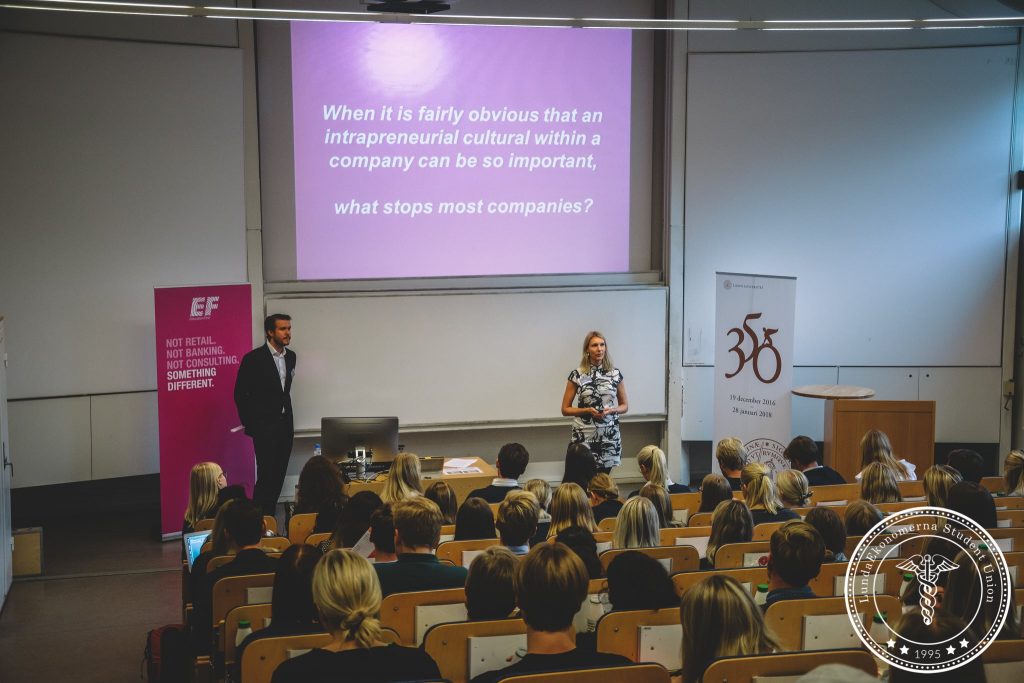
As a student at LUSEM you are given a lot of opportunities to meet, mingle and listen to company representatives. This time, The Corporate Relations Committee arranged a lunch lecture with the international education company EF. Lundtan was lucky enough to grab a free poke bowl lunch while listening to the company’s representatives: Sofia and Marcus.
It turns out we had more in common with Marcus and Sofia than we first thought. To our joy, they were both former LUSEM students. This announcement was followed by a short introduction about themselves, the history of EF and what the company does (and if you didn’t already know, EF was actually founded right here in Lund!). When they asked if there was anyone who have travelled or in any way been a part of an EF-program a lot of hands went up in the air.
A major part of the lecture was spent talking about intrapreneurship, which is defined as entrepreneurship but within a large organization, and the value of being an intrapreneur at EF. Instead of working as one big company they divide the company into smaller business and let them “run their own show”. Even though that might sound a bit risky, EF presents it as a winning concept. To demonstrate this, Marcus and Sofia showed a picture of a woman named Madeleine, who became an intrapreneur at EF when she questioned the efficiency of the iPads in language schools and after that started the organization EF Class, a digital learning tool to use in the classroom.
With more than 500 offices around the world there is a lot of ways to get into EF. Marcus told us about when he started his career as an intern in Amsterdam. Even though he had a rough start, he got a lot of opportunities to develop, both within the company and as a person. With just two weeks into his internship he came up with an idea to change a strategy in his area of work.
All these stories show the value and the interest EF puts into their employers and interns. To be a successful company, you need to adapt to the environment. Nowadays everything is in constant change, from technology and our market overall, to our society. In other words, EF are looking for people that wants to become the intrepreneurs of today, and start off their career at EF.
Towards the end of the lecture, one of the listening students asked: “What’s the best with working at EF?” and both Marcus and Sofia smiles and answered quickly: “The people! All the employees at EF are driven, open-minded and believe in what they do. To work with this kind of people is both inspiring, motivating and a lot of fun.”